
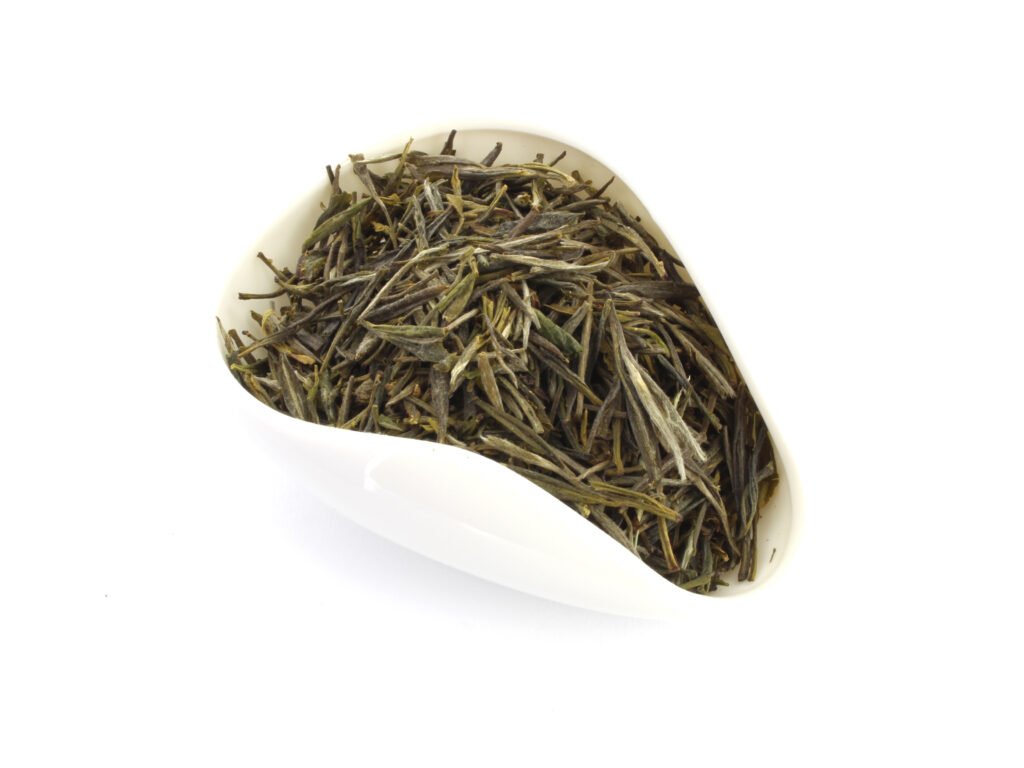
Yellow tea is the rarest category most people have never heard of, and it is fading. Production has fallen off over the past few decades because the process is slow, hands-on, and hard to scale. (Tea Guardian) What survives is worth your attention. Yellow tea sits between green and oolong, made like a green but with one extra step that changes its whole texture.
What Defines It
The processing mirrors green tea with a single addition. The result is smooth and mellow, less grassy and less bitter than green, with a soft sweetness and a rounded body. It is one of the least produced teas in the world. Most of it comes from Hunan, Sichuan, Anhui, and Zhejiang.
How It’s Made
Yellow tea is made almost exactly like green, with one critical step, menhuang (闷黄), a sealed yellowing that remakes the character of the leaf. We kill the green first, usually by pan-firing, then give the leaf a light rolling. Then the menhuang. Still warm and slightly damp, the leaf is wrapped in cloth or paper and left to rest. Trapped heat and moisture drive a slow, mild, non-enzymatic change over anywhere from a few hours to several days. The leaf turns yellow. The grassy edge of green tea softens into something quieter and harder to find. A final firing halts the yellowing and locks in the flavor. That step is exactly why yellow tea is disappearing. It demands precise timing and constant attention and cannot be rushed, so many producers have dropped it and sell the result as green.
The Grades
Yellow tea is sorted by leaf size. Yinzhen (银针), Silver Needle, is buds alone, the most prized and delicate grade, and Junshan Yinzhen (君山银针) from Hunan is the most famous yellow tea there is. Xiao Cha (小茶) uses young leaves with some buds and carries more body. Da Cha (大茶) is mature leaf, rarely seen outside China, earthy and substantial.
Where It Comes From
Junshan Island in Hunan (君山银针) is the definitive source. Mengding Mountain in Sichuan (蒙顶黄芽) is one of the oldest tea regions in the country. Huoshan in Anhui (霍山黄芽) is respected if less known. They are not interchangeable. Each origin makes a tea with its own character despite the shared category name.
Varieties We Cover
More coming soon.