
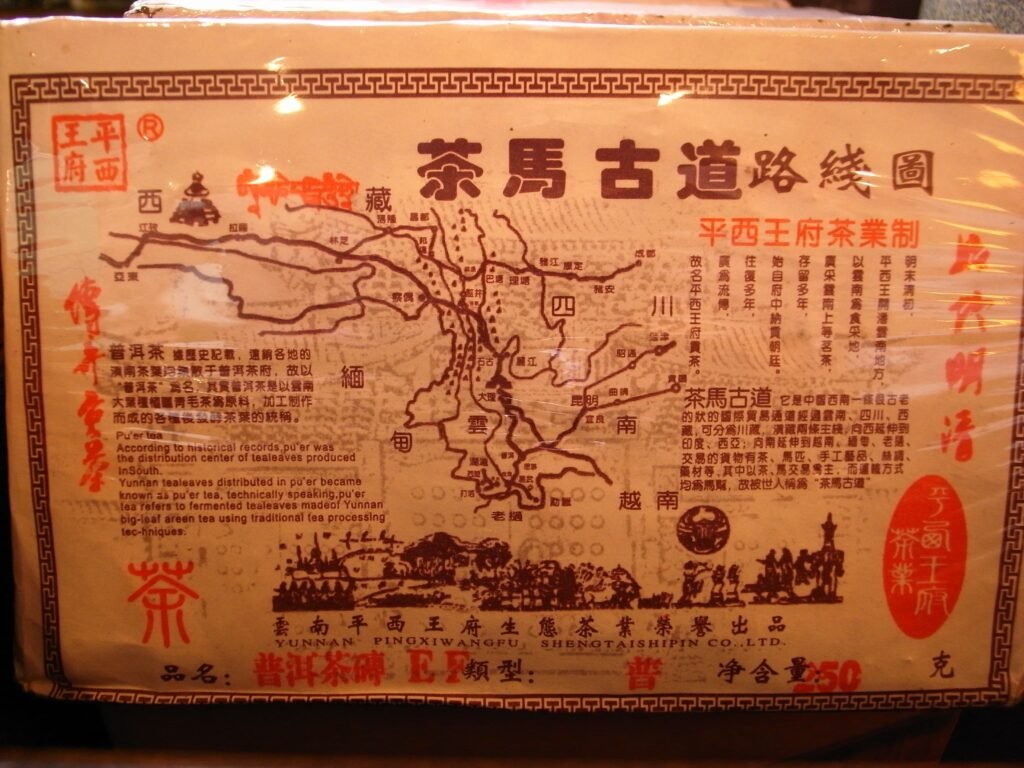
Pu’er (普洱茶 / pǔ’ěr chá) is the most misunderstood category in tea, and for the people who fall into it, the most obsessive. We make it from large-leaf Camellia sinensis var. assamica grown in the old forests of Yunnan, and it is the one tea built to improve with age, sometimes over decades. It comes pressed into cakes, bricks, and nests. It trades like fine wine. And it splits into two teas that share a name and little else.
Two Teas, One Name
The first thing to understand is that “Pu’er” covers two very different teas, sheng (生, raw) and shou (熟, cooked or ripe). They begin with the same leaf and part ways after harvest.
| Sheng Pu’er 生普洱 | Shou Pu’er 熟普洱 | |
|---|---|---|
| Also called | Raw, green, uncooked | Ripe, cooked, black |
| Processing | Withered, pan-fired (kill-green), sun-dried, compressed. Natural fermentation over time. | Same as sheng up to sun-dried maocha, then wet-piled (渥堆) for 45–60 days, then compressed. |
| Young flavor | Bitter, astringent, grassy, sometimes floral. Challenging but complex. | Earthy, mushroom, dark fruit, smooth. Approachable at once. |
| Aged flavor | Honey, dried fruit, forest floor, camphor. Legendary when done right. | Mellows further, silkier, with wood, dates, leather. |
| Typical aging | 5–30+ years. Some 1990s cakes sell for thousands each. | Drinkable now; improves up to ~15 years. |
| Storage importance | Critical. Dry vs wet storage creates very different outcomes. | Less critical than sheng, but still benefits from good conditions. |
Sheng Pu’er 生普洱, The Long Game
Sheng is defined by patience. Young sheng, often called qingbing (青饼, green cake), is bright, bitter, and rough at the edges. Most serious collectors buy it young and store it, waiting years or decades for natural fermentation to do its work. At its best, from the best material, the result is something no other tea can reach, a depth that seems to hold time itself.
The raw material decides everything. Sheng from ancient trees (gushu 古树, old arbor) is prized over plantation leaf (taidi 台地). Old trees have deeper roots, lower yields, and a complexity that reflects the ecology of their particular mountain, what the Chinese call shanyun (山韵), the resonance of the mountain.
Young sheng, one to five years, runs bitter and green, sometimes floral or fruity, high in catechins, punishing and energizing like a green tea. Through five to fifteen years the bitterness softens and plum, dried apricot, and honey come forward. Past fifteen years it turns to deep earth, camphor (樟香 zhāng xiāng), dried fruit, and forest floor, and the best examples take on an almost meditative quality, the tea drunk feeling people chase.
Shou Pu’er 熟普洱, Patience Compressed
Shou was developed in 1973 by the Menghai and Kunming tea factories, with mass production from 1975, as a way to make aged-tasting pu’er without the twenty-year wait. The wodui process (渥堆), piling moistened maocha in a warm, humid space for up to two months, compresses decades of fermentation into weeks. (TeaDB) The result is its own tea, dark, earthy, smooth, and approachable.
Good shou is not a shortcut. It is a category in its own right. The raw material, the skill of the pile, and the storage afterward all shape the cup, and high-quality shou from gushu material, stored well, is a genuinely great tea.
Young shou, zero to three years, can carry a fishy or pile smell (堆味 duī wèi) from the wodui, which airs out with time. From three to eight years it settles into classic territory, earthy and warming with dark mushroom and dried dates. Past eight years it turns silkier, with wood, sweetness, and sometimes a red-date (红枣) note.
Xishuangbanna 西双版纳, The Heartland
This is where the mythology of pu’er lives, home to some of the oldest tea trees on earth, a few estimated at 500 to 1,000 years, and to the villages that command the highest prices anywhere. Lao Banzhang (老班章) is the most famous and the most faked, known for powerful, bold teas whose intense bitterness turns into a long, sweet huigan (回甘, returning sweetness); authentic material runs past 1,000 USD per kilogram of maocha, so buy with deep skepticism. Yiwu (易武) is its elegant counterpart, the center of the 19th-century pu’er trade, prized for floral aromatics, softness, and exceptional aging. Nannuo (南糯) is one of the oldest tea mountains, with documented ancient trees, medium-bodied and floral and reliably good. Jingmai (景迈) sits on the Pu’er City border and is famous for an orchid fragrance (兰花香) drawn from its forest ecosystem, now a UNESCO World Cultural Heritage site as of 2023. Menghai (勐海) is not a single village but a county, home of the Menghai Tea Factory (大益 Dayi) and the industrial center of pu’er.
Lincang 临沧, The Value Region
Lincang has grown into a source of both high-quality and value pu’er. Its best-known sub-regions are Mengku (勐库) in Shuangjiang county, which makes broad, full-bodied teas that age well, and Bingdao (冰岛), arguably the only village that rivals Lao Banzhang for price and prestige, known for a paradoxically sweet, gentle character that belies the cost.
Pu’er City 普洱市, The Original
Once called Simao (思茅), this prefecture is the largest in Yunnan and gave the tea its name. Pu’er was the trading hub through which the compressed teas passed on their way to Tibet, Southeast Asia, and beyond. Jingmai Mountain is its most celebrated origin, and today the area makes everything from commodity grade to small-lot artisan tea.
Baoshan 保山, The Underrated Northwest
Baoshan comes up less in collector circles but produces solid material, generally lighter and more approachable. Worth exploring for value-minded sheng that won’t break the bank.
Aging & Storage
No category is more shaped by storage. Two identical cakes stored differently for ten years taste like different teas, and which one is better comes down to your own palate.
| Storage Type | Conditions | Resulting Character |
|---|---|---|
| Dry Storage 干仓 | Low humidity (<75%), controlled temperature. Traditional in Kunming or dry climates. | Slower transformation, cleaner profiles. Preserves more terroir. Preferred by purists. |
| Wet Storage 湿仓 | High humidity (75–90%+), warm. Common historically in Hong Kong and Guangdong. | Faster transformation, deeper earthiness. Classic Hong Kong style. Can turn musty if overdone. |
| Natural / Transitional | Ambient storage matching the local climate. Most home storage. | Varies by climate. Guam’s humidity ages tea faster, so store with care. |
For storing in Guam, our humidity runs high. Keep pu’er away from direct moisture, avoid temperature swings, and give it airflow. A dedicated space with some humidity control goes a long way.
Brewing Pu’er
| Sheng Pu’er | Shou Pu’er | |
|---|---|---|
| Water temp | 95–100°C (just off boil) | 100°C (full boil) |
| Leaf ratio | 5–8g per 100ml | 6–8g per 100ml |
| First rinse | Yes, 5–10 sec to open the leaf | Yes, 10–15 sec, especially for young shou |
| Steep times | Short, 10 sec to start, extending gradually | Slightly longer, 15–20 sec to start |
| Steepings | 8–15+ from quality material | 6–12 |
| Vessel | Gaiwan or unglazed Yixing (zisha) | Yixing clay teapot, ideally dedicated to shou |
Break pieces off a compressed cake with a pu’er pick (茶针 chá zhēn), prying from the side to keep the leaves as whole as you can. Loose or broken leaf brews harder; large intact chunks give you more control.
Our Take on Pu’er
Pu’er is where our curiosity runs deepest, and we source carefully as real, legitimate, quality pu’er turns up on the market. One caution we give freely: the pu’er market has a well-documented authenticity problem. Lao Banzhang and Bingdao are valuable enough that more fake exists than real. If someone offers you authentic Lao Banzhang at a reasonable price, hold onto your skepticism. We would rather point you toward verifiable quality than hype.
Pu’er rewards patience, in the tea and in the learning. If you are starting out, try a good shou first and let it make sense. Then, when you are ready, find a few samples, whether from a shop or online, and drink each one three times across a week. Let your palate get used to the tea’s original environment. That is when understanding begins.