
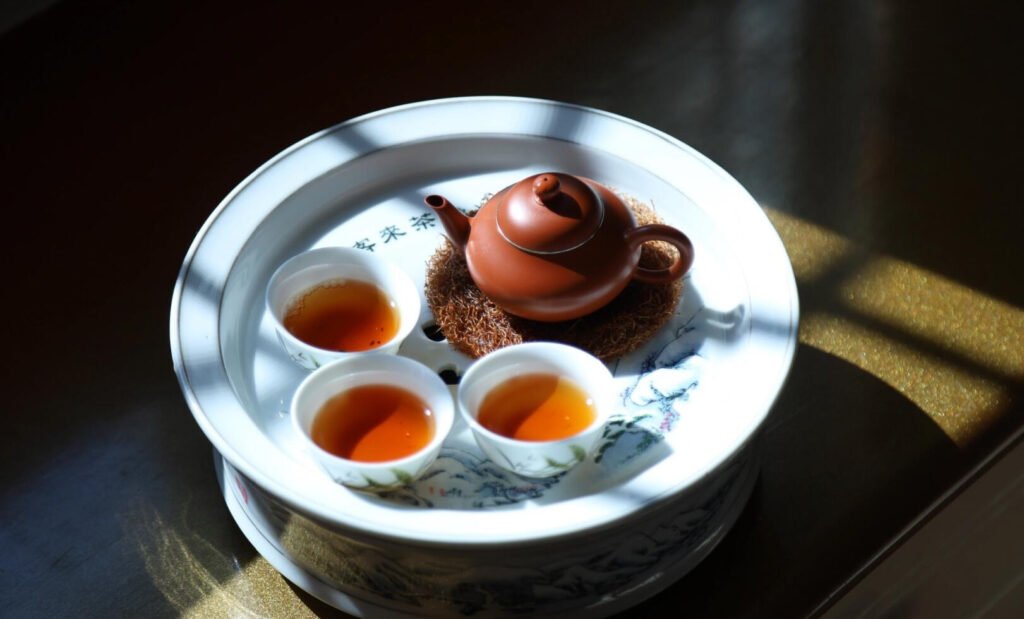
Chaozhou Gongfu Cha (潮州工夫茶 / Cháozhōu Gōngfū Chá) is the original, the form everything else in Chinese gongfu culture grew out of. It is stricter, faster, and more demanding than the modern adaptation. And it is inseparable from one tea, Phoenix Dancong.
The Teochew Tradition
Chaozhou (潮州), also spelled Teochew or Chaoshan, is a region in eastern Guangdong, and the Teochew diaspora carried this tea culture across Southeast Asia and beyond. The style has run more or less unbroken for centuries. China recognized it as intangible cultural heritage in 2008, and in 2022 UNESCO added it to its Representative List as part of China’s traditional tea processing techniques.
Three things define the ritual: a tiny pot packed tight with leaves, flash infusions counted in seconds, and three cups poured at once for guests. The host always drinks last.
What Makes It Different
The leaf ratio is high. Chaozhou pots are packed seventy to eighty percent full, far more leaf than standard gongfu, and that density is what builds the concentrated, layered infusions the style is known for. If you aren’t used to it, the first cup will hit hard. The infusions run fast, five to fifteen seconds, sometimes less on the first pour. Speed is part of the technique, because the packed leaves and small volume extract quickly. Time it badly and the cup turns bitter; time it well and it comes out bright, floral, almost electric. And the three cups are served together. The host pours in a continuous circular motion across all three at once, a move called 關公巡城 (Guān Gōng xún chéng, Guan Yu patrols the city), then distributes the last drops evenly, 韓信點兵 (Hán Xìn diǎn bīng, Han Xin counts his troops), so no cup is stronger or weaker than another.
The Vessels
The traditional setup uses a small zhuni clay pot (朱泥壺 / zhū ní hú), 60 to 100ml, sometimes smaller. Zhuni (朱泥) is a fine-grained red clay native to Chaozhou, distinct from Yixing zhuni, and well matched to high-aroma oolong. It heats fast, cools fast, and does not smother the fragrance the way heavier clays can. The cups are small too, 20 to 30ml, and traditionally white or very thin porcelain, so each one is drunk quickly while the tea is hot and fragrant.
The Session
The water must be at a full boil, 100°C. The first infusion is a rinse, discarded at once. Then the real steeps begin, fast and precise, poured the moment the timing is right. A good Chaozhou session yields eight to twelve infusions from a single packing, each one a little different from the last.
Best Teas
Phoenix Dancong (凤凰单丛 / Fènghuáng Dāncōng) is the tea for this style, full stop. (Tea Guardian) The Chaozhou tradition and Phoenix Dancong grew up together, and the style was built around this tea’s aromatics. Duck Shit (鸭屎香), Honey Orchid (蜜兰香), and Magnolia (玉兰香) each express differently across the flash infusions. You can brew other high-aroma oolongs this way, but they will perform differently. Chaozhou Gongfu Cha was never a general method. It was designed for one tea. Respect that, and the results will show it.