
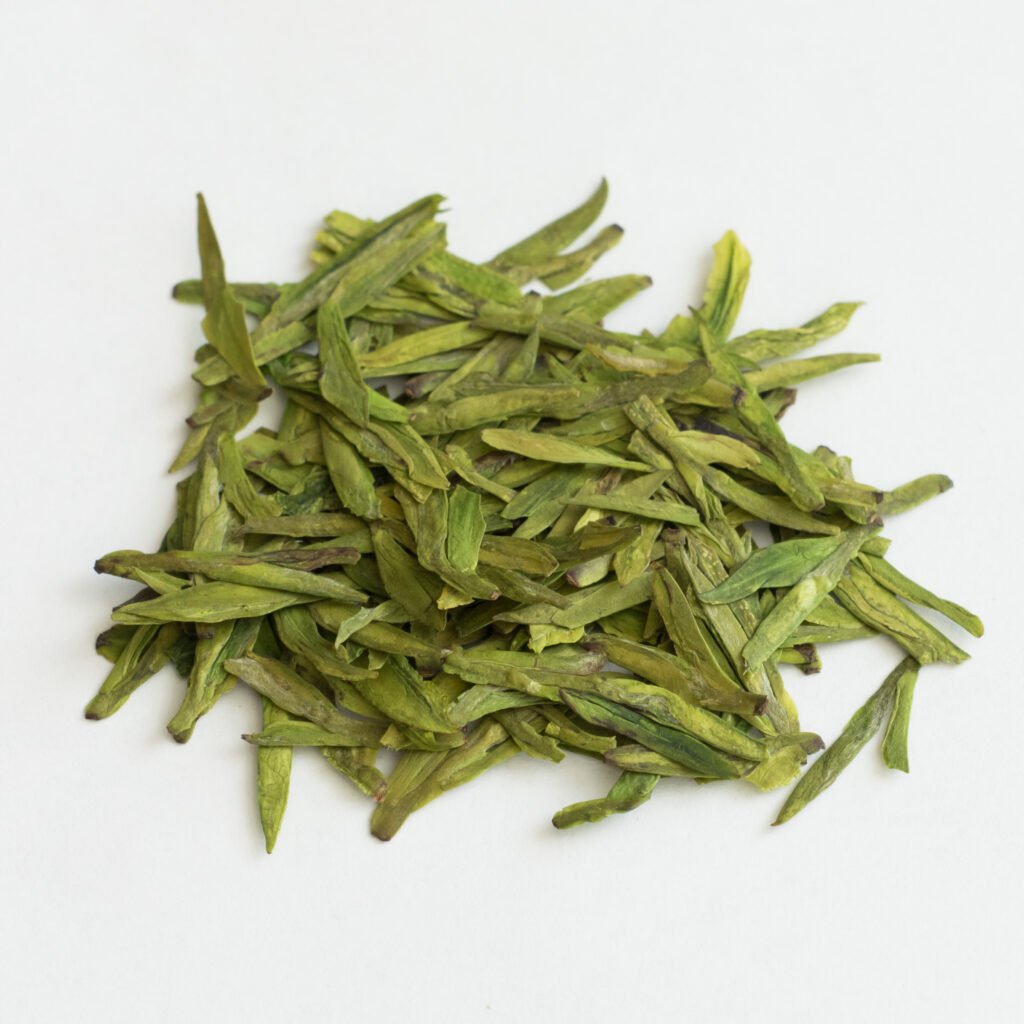
Cold brew is not iced tea. The distinction matters. What cold water extracts from tea leaves is fundamentally different from what hot water extracts, and the cup is noticeably different because of it. Sweeter, lighter, and cleaner, without changing anything about the leaf.
What’s Actually Happening
Tea extracts compounds through heat, time, and water. Hot water accelerates extraction. Cold water slows it down, and the compounds that require heat to become soluble either extract partially or not at all.
The main ones are catechins: a family of polyphenols that includes EGCG (epigallocatechin gallate), the most abundant and most studied compound in tea. Catechins are largely responsible for the astringency and a significant portion of the bitterness in a hot-brewed cup. Cold water leaves most of them behind. What you’re left with is a brew where the tea’s natural sweetness, derived from amino acids like L-theanine (茶氨酸 / chá ānjī suān), becomes far more apparent. (Alcázar et al., 2007)
L-theanine is the compound that gives green tea its characteristic savory-sweet quality, sometimes described as umami. It extracts readily at low temperatures, which is why Japanese tea culture has long preferred cold-brewing for high-grade gyokuro (玉露), the variety with the highest L-theanine content. The Japanese term is 水出し (mizudashi, “water draw”), and it has been practiced for generations. Cold brewing is not a modern trend that discovered something new. It uncovered something old.
Caffeine also extracts at lower levels in cold brew, though the difference varies considerably depending on leaf type, grind, and time. Cold brew is not caffeine-free. Expect a gentler cup, not an inert one.
How to Do It
The method is simple enough that getting it wrong is almost difficult. You need loose leaf tea, cold or room-temperature water, a container, and time. That is the complete equipment list.
Start with 4 to 6 grams of loose leaf per 500ml of water. Cold water extracts less efficiently than hot, so the ratio is higher than you’d use for a standard hot brew. If you prefer something lighter, go closer to 4g. If you want to taste what the tea is capable of, push toward 6g. The ratio is more forgiving here than in gongfu brewing. You have time as a buffer.
For time: in a refrigerator at 4 to 8°C, most teas need 8 to 12 hours. At room temperature (around 20 to 22°C), extraction is faster, typically 4 to 8 hours, and produces a slightly more astringent result. The refrigerator produces a cleaner cup. Room temperature is faster and works fine when you’re in less of a position to plan ahead.
Strain when the time is up. Cold brew keeps well for 2 to 3 days refrigerated. It does not improve after that, and with some teas it degrades. Make what you’ll drink.

Which Teas
Green and white teas are where this method excels. The lower extraction temperature is, in a real sense, what these teas were designed for. Bitter, overbrewed green tea is almost always a hot-water problem. Cold brewing removes it. Longjing (龙井), high-grade gyokuro, silver needle white tea (白毫银针), and all of them produce something delicate and clean that hot brewing struggles to replicate. Silver needle cold-brewed for 10 to 12 hours in the refrigerator is one of the most quietly impressive cups you can make.
Oolong teas cold brew well, particularly lighter and more floral styles. Tieguanyin (铁观音), Jin Xuan, and high-mountain Taiwanese oolongs all produce aromatic, clean brews. Heavily roasted oolongs, Wuyi rock oolongs for instance, need longer extraction and produce something more unusual. The roast character softens in cold water rather than disappearing. It’s worth trying, but not the obvious starting point.
Black teas will cold brew, but they need more time than people expect. Twelve to eighteen hours minimum for decent extraction. The result tends to be mellower and less structured than a hot-brewed black tea, which works for some and not for others. Darjeeling first flush responds well. Dianhong golden bud less so, since the character that makes it distinctive depends on the warmth.
Fermented teas are underexplored here. Sheng pu-erh (生茶) cold brew is quieter and more interesting than you might expect, and the aged complexity comes through without the heat-activated earthiness. Shou pu-erh (熟茶) cold brew is more polarizing. Experiment with caution and an open mind.
Cold Brew vs Iced Tea vs Flash Chilling
These are three distinct methods that get conflated, and they produce noticeably different results.
Iced tea is hot-brewed tea that has been chilled or poured over ice. The hot extraction pulls out tannins and catechins that then have nowhere to go but into your cup, often landing as harshness or bitterness in the final chilled drink. Ice dilution does not fix this. You are working against yourself from the start.
Flash chilling is the middle path and more interesting than it sounds. Brew hot at roughly double concentration, half the normal water volume, and pour directly onto ice to chill the tea instantly. The rapid drop in temperature arrests the extraction at a specific point, before the tannins have time to develop fully. You get a crisper result than standard iced tea, without the 10-hour commitment of cold brew. It’s a legitimate technique worth knowing.
Cold brew begins at cold and stays there. The slowness is the point. Of the three, it produces the most distinct cup: lowest tannin content, most perceived sweetness, lightest body. Which method is right depends on what you want and how much time you have. But they are not interchangeable.
What We Don’t Know
The science on cold brew tea is thin. Most research on tea polyphenol extraction uses hot water, and cold brew comparisons represent a small and recent slice of that literature. What we know with confidence: lower temperature means lower extraction of catechins and caffeine. The direction is well-established across multiple studies. (Venditti et al., 2010)
What is less certain: the magnitude. Extraction rates vary considerably depending on leaf type, how finely the leaf is processed, water mineral content, and ambient temperature during brewing. The ratios and times we give above are grounded in well-regarded practice. They are not derived from controlled trials and should be treated as starting points, not fixed rules.
Health claims that go further than “different extraction profile” are not well-supported. Cold brew is not significantly higher in beneficial compounds than hot brew. If anything, it is lower in total polyphenols. If someone is selling cold brew on the basis of elevated antioxidant content, they have the chemistry backwards. What cold brew does offer is a genuinely different and often more enjoyable cup for certain teas. That’s a real benefit. It’s just not a medical one.
Sources
Alcázar, A. et al. (2007). Differentiation of green, white, black, Oolong, and Pu-erh teas according to their free amino acids content. Journal of Agricultural and Food Chemistry, 55(15), 5960–5965. doi:10.1021/jf070601a
Venditti, E. et al. (2010). Hot vs. cold water steeping of different teas: Do they affect antioxidant activity? Food Chemistry, 119(4), 1597–1604. doi:10.1016/j.foodchem.2009.09.029
Xu, Y. Q. et al. (2018). Determining the quality of cold-brewed tea: Effects of extraction conditions on the chemical components and sensory qualities. Food Chemistry, 265, 101–108. doi:10.1016/j.foodchem.2018.05.060
Mancini, E. et al. (2017). Green tea effects on cognition, mood and human brain function: A systematic review. Phytomedicine, 34, 26–37. doi:10.1016/j.phymed.2017.07.008