
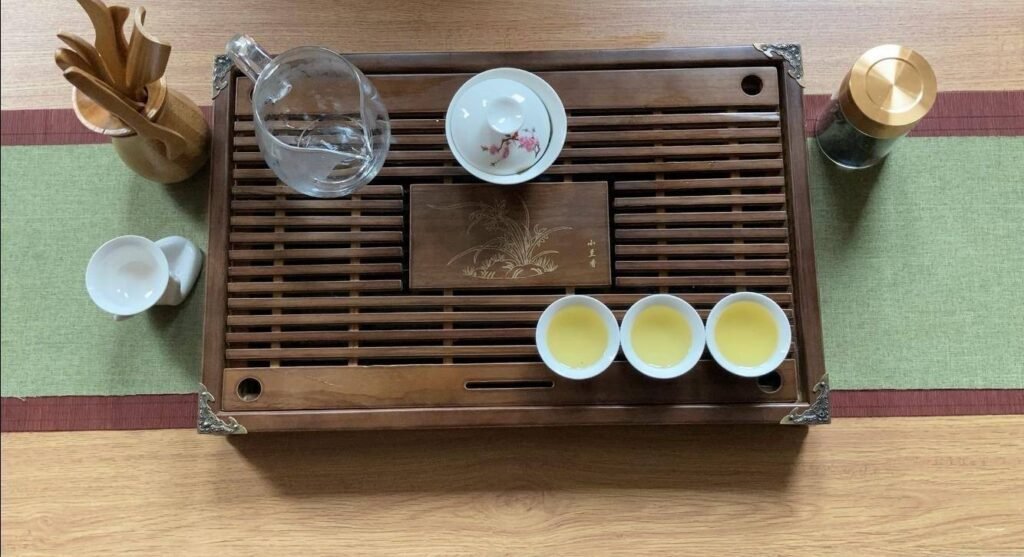
Gongfu Cha (工夫茶 / gōngfū chá), literally tea made with skill and effort, trades volume for depth. Small vessel, more leaf, shorter steeps, many rounds. Each infusion is its own moment, and the tea tells you when it is finished. It will change how you think about tea.
What Gongfu Means
工夫 (gōngfū) means skill earned through time and practice, the same character behind the English word kung fu. In tea it means just that, learning to read the leaf, adjust to the water, and build a feel for timing that no chart fully captures. It is not a ceremony. It is a practice. The modern gongfu approach grew out of the Chaozhou tradition but runs looser and more adaptable. (TeaDB) You can brew almost any tea this way. The core idea holds steady: short, concentrated steeps that reveal a different face of the tea each time.
Why Bother
Control, control, control. You hold the whole outcome in your hands. And instead of a diluted, somehow-still-bitter mug, you drink small, concentrated, flavorful shots of tea, each one different from the last.
The Essentials
You don’t need much. The minimum that works is a gaiwan or small teapot, small cups, hot water, and something to catch overflow, whether a tea tray (茶盘 / chá pán) or a towel. A fairness cup (公道杯 / gōngdào bēi), the vessel you pour into between the gaiwan and the cups, is not required, but it evens out the pour and lets the tea breathe, and it makes hosting easier.
Ratios and Temperature
A good starting ratio is half a gram of leaf per 10 to 15ml of water. (TeaDB) A 100ml gaiwan takes 5 to 10g depending on the tea. Dense rolled oolongs need less by volume; fluffy white teas need more. Adjust to what you taste, not just what you measure. Take our numbers as a nudge toward your own preference rather than a rule. With the exception of green tea, good tea holds up across a range of temperatures, and what you really adjust is the steep time. That is where the gongfu takes shape.
| Tea Type | Temperature | First Steep | Add per Steep |
|---|---|---|---|
| Green tea | 70–80°C | 20–30 sec | +5 sec |
| White tea | 85–99°C | 20–45 sec | +5–10 sec |
| Light oolong | 90–99°C | 20–30 sec | +5 sec |
| Roasted oolong | 95–100°C | 20–30 sec | +5–10 sec |
| Black tea | 90–97°C | 15–25 sec | +5 sec |
| Sheng pu’er | 90–95°C | 15–25 sec | +5–10 sec |
| Shou pu’er | 95–100°C | 10–20 sec | +5–10 sec |
The Session
A rinse is common, though not required. Pour hot water over the empty vessel and into the cups, then tip it out, which warms the teaware. Load your leaves, close the lid, and give it a shake, then smell the lid. It should smell wonderful. Now rinse the leaves: pour boiling water over them, swirl for five to ten seconds, and pour it off. This wakes the leaves and rinses any dust, and it is worth doing for compressed pu’er and heavily roasted teas. For rolled or compressed teas, leave the rinse a little longer so the leaf can begin to open, and keep an eye on it. Pour the rinse into the cups to smell the aroma, or discard it, or give it to your tea pet, or just drink it if you are feeling lazy. Smell the lid again, and notice whether the aroma shifts or strengthens.
Now the first real brew. Each steep adds a few seconds over the last. The tea opens, peaks, then slowly fades, and at some point the taste tells you there is nothing left to give, usually after six to ten steeps, more for aged or compressed teas. The pour has its own logic. A high arc aerates the tea and drops the temperature a little before it lands. A low arc keeps the heat and body, useful for roasted oolong and pu’er where you want full extraction temperature. Neither is wrong. Let the tea decide. Between steeps, leave the lid ajar and smell it. The fragrance there, the 盖香 (gài xiāng), is often the most concentrated aromatics of the tea, and you can track the session by how it changes.
Reading the Steeps
A tea that starts thin usually has more to give; it was under-leafed or brewed too cool. A tea that starts bitter was over-leafed or brewed too hot. Neither is a disaster. Adjust the next session. Gongfu brewing is iterative, and the point is not to nail it on the first try but to understand the tea a little better each time.