
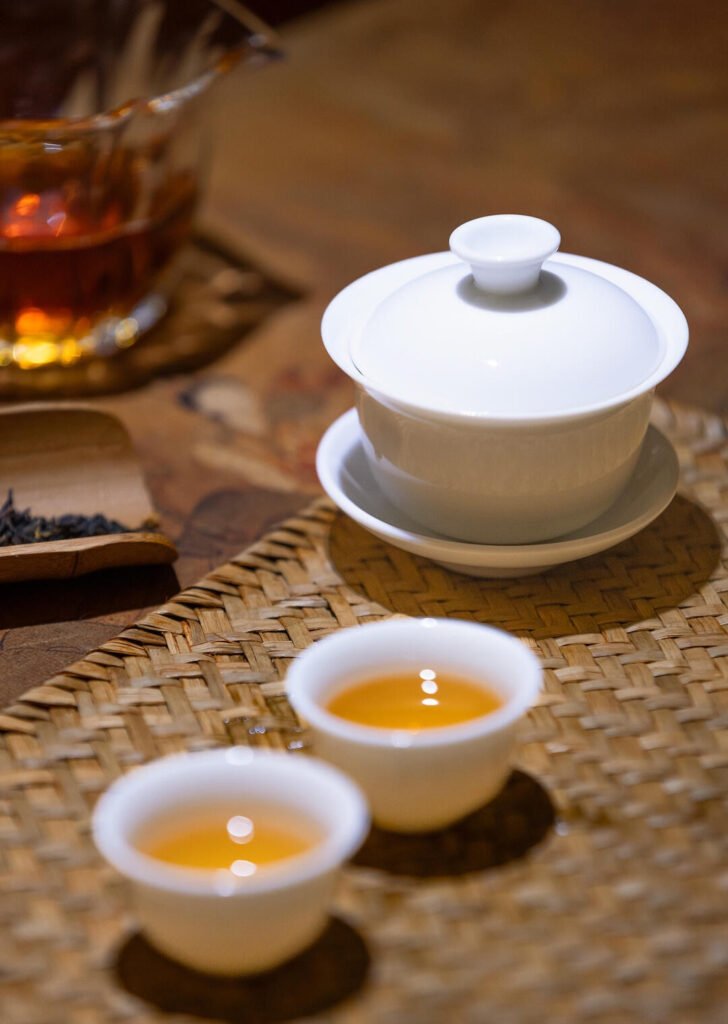
The gaiwan (盖碗 / gài wǎn), the lidded bowl, is the most versatile vessel in Chinese tea. Bowl, lid, and saucer, three pieces that together handle brewing, straining, and serving. Once you learn it, going back to anything else is hard.
It started as a drinking vessel, and still is one in Sichuan, but it has become a brewing vessel above all. Its simplicity is the whole reason it spread. A cup and a lid, and yet it can brew exceptional tea.
Why We Love It
Cleaning a gaiwan takes seconds. Tip out the leaves, rinse the bowl, done, far easier than digging leaves out of a teapot. And you can watch the steep happen in real time. Lift the lid and look. The wide mouth makes the whole process visible.
Anatomy of a Gaiwan
A gaiwan has three parts, each with a job. The bowl (碗 / wǎn) holds the tea and water. The lid (盖 / gài) works as a strainer and as a tool for reading the wet leaves. The saucer (托 / tuō) is a resting place for the bowl, and it also shields your hand from the heat, gives you something stable to hold, and doubles as a serving tray if you drink straight from the gaiwan. Together the three are called the 三才碗 (sān cái wǎn), the Three Talents bowl, for heaven in the lid, earth in the saucer, and humanity in the bowl. Cosmology aside, it is a well-designed system refined over centuries.
Material Matters, But Not How You Think
Most advice fixes on porcelain versus clay, and that matters, but wall thickness matters as much. A thin-walled gaiwan, under two millimeters, loses heat fast. A thick-walled one holds temperature through the steep. (TeaDB) Thickness also decides how much the rim hurts to hold, since a thin gaiwan moves heat to the edge quickly and pouring can burn your fingers.
Porcelain (瓷 / cí) is the default, and a good one. It is non-porous, flavor-neutral, and easy to clean, and it won’t carry one tea’s oils into the next. White porcelain shows the color of the soup. Start here. Clay (陶 / táo), especially Jianshui purple clay or Nixing clay, is a step up once you know what you want. It is porous, harder to clean, and it holds flavor memory between sessions. That is a feature when you dedicate one vessel to a single tea, and a problem when you brew a variety. For range, porcelain stays cleaner in every sense.
The Trilemma
Every gaiwan balances three things: flavor neutrality, heat retention, and weight. You get two, not all three. Thin zhuni clay is light and heat-retaining but porous. Thick porcelain is neutral and holds heat but it is heavy. Thin porcelain is light and neutral but loses heat fast. Know which trade you are making before you buy.
Design Matters Too
A badly designed gaiwan is a miserable thing to use. A good one has three traits: a wide flared rim, a stable foot, and a stable lid. The wide flared rim gives your fingers room to work without scorching, and it guides the pour. A stable foot keeps the gaiwan from tipping, which is the last thing you want with a bowl of near-boiling water. A stable lid means a stable pour, since a top-heavy lid flips easily, and you always angle the lid when you pour.
How to Use a Gaiwan
You can drink straight from a gaiwan, filtering the leaves with the lid, or open it and drink from the bowl. For brewing, there are two common holds, the three-finger method (三指法) and the respectful handheld method (手容恭).
For the three-finger method, which we do with four fingers for stability, the instructions assume a right-handed grip, so reverse them if you are left-handed. Start with the lid. Angle the nine o’clock position down a little to open a small gap that strains the leaves as you pour. Then the grip. Lift your elbow and point your fingers down. Pinch the rim with your thumb at six o’clock and your middle finger at twelve, support the middle finger lightly with your ring finger, and rest your index fingertip or first knuckle on top of the lid. Lift, keeping leverage between lid and bowl, then turn your wrist to pour. A good pour rewards confidence. Make it fluid and fast, because most burns come from hesitation rather than the vessel. After a few sessions the movement runs on its own.
Between steeps, rest the lid ajar across the bowl. This lets the leaves breathe and stops the tea over-steeping. While the lid is off, bring it close and inhale. That is the gài xiāng (盖香), the lid fragrance, often the most concentrated expression of the tea’s aroma before dilution or cooling change it.
The respectful handheld method (手容恭) takes its name from pouring away from the guest, which reads as polite, and from using the whole hand. Angle the six o’clock position down, toward you. Lift the gaiwan with your non-dominant hand wrapped around the edge, then quickly support the base with the last three fingers of your dominant hand and press the span of the lid handle with the base of your thumb. Take the non-dominant hand away and pour toward yourself.
What to Brew
The gaiwan handles almost everything. It is the default for oolong, especially light and medium roasts where floral and fruity aromatics are the point. It is wonderful for white tea and sheng pu’er, where you want to track how the tea changes steep by steep. For green tea it works as long as you don’t pour boiling water straight onto the leaves. The one place a dedicated teapot has an edge is high-roast oolong and shou pu’er, which benefit from extra heat retention and clay absorption, though a thick-walled or clay gaiwan will still make both well.
Choosing Your First Gaiwan
Start with white porcelain, 100 to 120ml. That size suits one person, large enough for about half a cup per pour and small enough that you aren’t over-leafing to fill it. Avoid anything under 80ml until the pour mechanics feel natural, and lean toward thicker walls while you learn. The handle-free design is not a flaw. It is what makes the gaiwan fast and responsive once the grip clicks. Once porcelain feels easy, then look at clay, and by then you will know what you want from the material.